Liver supplements are frequently used in veterinary medicine to support hepatic function in animals with chronic hepatopathies, intoxications, cholestasis or prolonged drug therapies. Although SAMe (S-adenosylmethionine) is often perceived as an essential component, the specialist literature suggests that the clinical efficacy of hepatoprotection does not depend on a single ingredient, but on the combined action of multiple biological mechanisms.If you are a veterinary surgeon, this article analyses the mechanisms of multimodal hepatoprotection and the place of SAMe in context. If you are a pet owner and your dog has liver problems, you will understand why a good liver supplement contains multiple ingredients, not just one, and what each component does.
Quick summary
Liver disease in animals rarely involves a single mechanism. As a rule, several processes are simultaneously involved: inflammation, oxidative stress, hepatocyte membrane damage, alterations in bile flow and, sometimes, fibrotic processes.
SAMe is a methyl group donor involved in the synthesis of glutathione (an intracellular antioxidant). Used alone, its effects are variable. Benefits appear more consistently when it is combined with other hepatoprotective ingredients.
Silymarin (from Silybum marianum) stabilises the cell membrane and has antioxidant and anti-inflammatory properties. Other substances influence lipid metabolism, hepatic detoxification or cell regeneration.
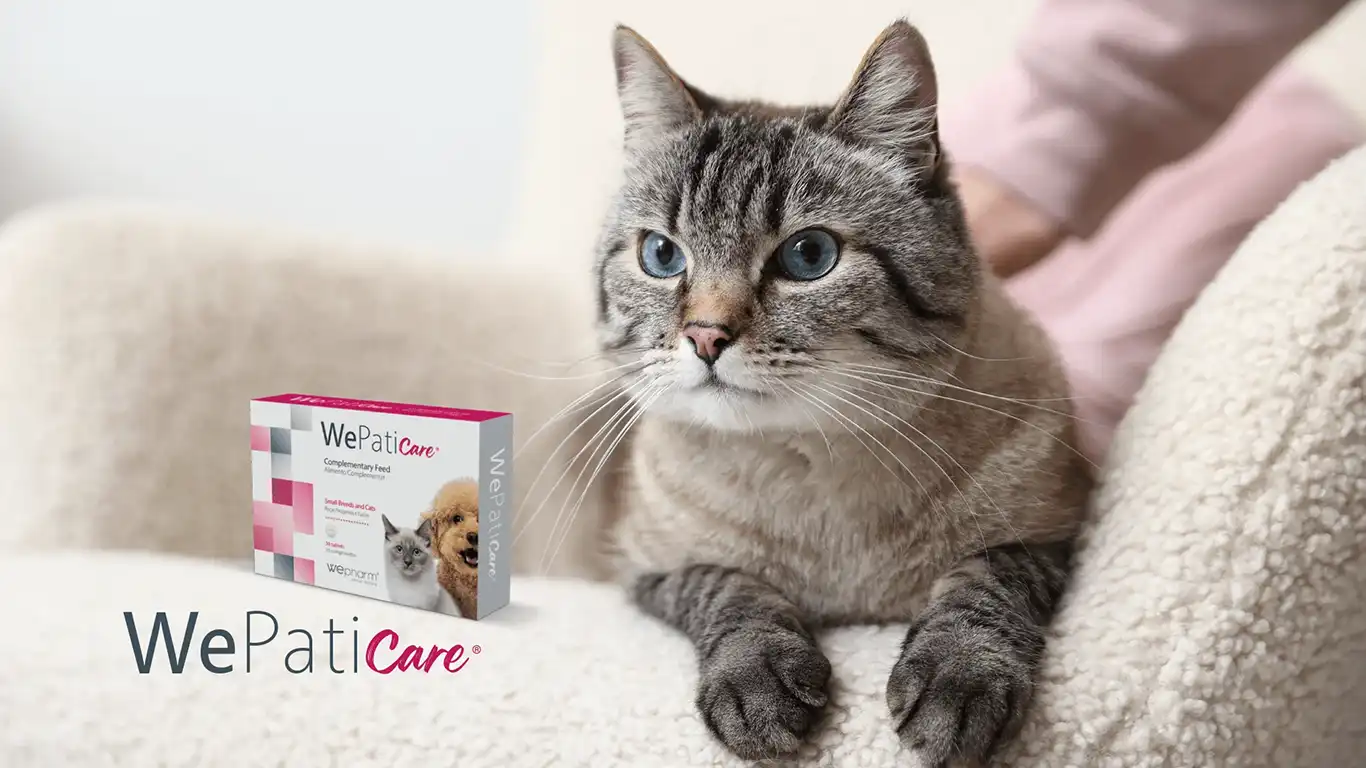
Wepaticare® (WePharm) combines in a single formula: silymarin (Siliphos), dandelion, turmeric, artichoke, Astragalus, Ginkgo biloba, lecithins, vitamin E, B-complex, BCAA, zinc, selenium and Enterococcus faecium. Pleasantly flavoured tablets, 30 per box.
Jump to:
- The role of SAMe in hepatoprotection: useful, but not sufficient alone
- Why liver disease requires a multimodal approach
- Silymarin and other hepatoprotectors with complementary mechanisms
- Full composition of Wepaticare®
- How to administer Wepaticare®
- Clinical implications: how to choose a liver supplement
- Frequently asked questions
- Bibliography
- Further reading
The role of SAMe in hepatoprotection: useful, but not sufficient alone
SAMe (S-adenosylmethionine) is a methyl group donor involved in numerous metabolic reactions and plays an important role in the synthesis of glutathione, one of the main intracellular antioxidants. Experimental studies have shown that SAMe administration can increase hepatic glutathione levels and reduce oxidative stress under certain conditions.
However, clinical data indicate that the effects of SAMe used alone are variable. In many situations, the observed benefits appear when the substance is administered in combination with other hepatoprotective ingredients. Some studies suggest that monotherapy with SAMe may have a limited impact on the progression of liver diseases, whilst complex formulas may offer more consistent results (Center et al., 2005; Anstee & Day, 2012).
What does this mean for owners? SAMe is a useful substance, but a diseased liver needs several types of support simultaneously. A supplement containing only SAMe provides partial protection; one that combines multiple active ingredients can offer a broader spectrum of protection.
Why liver disease requires a multimodal approach
Liver disease in animals is rarely caused by a single mechanism. As a rule, several processes are simultaneously involved:
- Inflammation – the chronic inflammatory response damages hepatic tissue
- Oxidative stress – free radicals attack liver cells
- Hepatocyte membrane damage – the membrane of liver cells becomes vulnerable
- Alterations in bile flow – toxic bile acids accumulate and worsen the lesions
- Fibrotic processes – functional hepatic tissue is replaced by scar tissue
For this reason, modern therapeutic strategies include combinations of substances with complementary actions: antioxidants reduce oxidative stress, choleretic substances support the elimination of toxic bile acids, and membrane-stabilising compounds can limit hepatocyte destruction.
In simpler terms for owners: the liver performs many functions in the body (it filters toxins, produces bile, stores vitamins). When it becomes diseased, several functions are affected simultaneously. This is why a single ingredient cannot solve everything – a team of ingredients is needed, each with its own role.
Silymarin and other hepatoprotectors with complementary mechanisms
Silymarin (extracted from Silybum marianum / milk thistle) and its derivatives are widely used due to their antioxidant, anti-inflammatory and cell membrane-stabilising properties. The Siliphos complex (silybin + phosphatidylcholine) has a superior bioavailability compared with standard silymarin.
Other substances with documented hepatoprotective roles in the literature (Marchegiani et al., 2020):
- Dandelion (Taraxacum officinale) – choleretic effect, supports bile flow
- Turmeric (Curcuma longa) – anti-inflammatory and antioxidant properties
- Artichoke (Cynara scolymus) – choleretic and hepatoprotective effect
- Astragalus membranaceus – immunomodulatory and hepatoprotective properties
- Ginkgo biloba – antioxidant effect
- Lecithins (phosphatidylcholine) – hepatocyte membrane stabilisation, lipid transport
- Vitamin E – fat-soluble antioxidant, protects cell membranes
- B-complex vitamins – essential metabolic cofactors for hepatic function
- BCAA (branched-chain amino acids) – metabolic support in hepatopathies
- Zinc and selenium – enzymatic cofactors with antioxidant roles
- Enterococcus faecium – probiotic, gut-liver axis support
The review literature underscores that there is no universal molecule capable of acting upon all the mechanisms involved in hepatopathies, which explains the growing interest in multimodal formulas.
Full composition of Wepaticare®
Wepaticare® (WePharm) is a nutritional supplement developed to support hepatic function in medium and large-breed dogs, through an approach based on complementary mechanisms of liver protection. It is available as pleasantly flavoured tablets, 30 tablets per box.
Composition per tablet
- Siliphos (Silybin + Phosphatidylcholine complex, from Silybum marianum) – 70 mg
- Vitamin E – 70 mg
- Turmeric (Curcuma longa) – 35 mg
- Dandelion leaf (Taraxacum officinale) – 28 mg
- Zinc – 21 mg
- Lecithins (polyunsaturated phosphatidylcholine) – 14 mg
- Artichoke leaf (Cynara scolymus) – 14 mg
- Astragalus membranaceus – 14 mg
- Ginkgo biloba – 14 mg
- B-vitamin complex (B1: 7 mg, B2: 7 mg, B6: 3.5 mg, B9: 1.04 mg, B12: 0.35 mg)
- Oat bran – 7 mg
- BCAA (L-leucine, L-isoleucine, L-valine)
- Enterococcus faecium – probiotic
- Selenium – 0.07 mg
The formula thus combines 14 active ingredients with complementary mechanisms: antioxidant protection (Siliphos, vitamin E, Ginkgo, selenium), choleretic effect (dandelion, artichoke), anti-inflammatory action (turmeric), membrane stabilisation (lecithins, Siliphos), metabolic support (B-complex, BCAA, zinc) and gut-liver axis support (Enterococcus faecium, oat bran).
This multi-ingredient approach is the same philosophy applied in joint health support with We Joint Plus® (see the article on hydrolysed and native type II collagen) and in haematopoiesis support with WeHemo® (see the article on chelated iron in supporting anaemic patients).
How to administer Wepaticare®
Administration: orally, as they are (pleasantly flavoured for dogs) or mixed into the daily food.
Recommended doses
- Dogs 10-20 kg – 1 tablet/day
- Dogs 20-30 kg – 2 tablets/day
- Dogs over 30 kg – 3 tablets/day
Important: Wepaticare® is formulated for medium and large-breed dogs (over 10 kg). For small-breed dogs or cats, consult your veterinary surgeon for suitable alternatives from the WePharm range.
Clinical implications: how to choose a liver supplement
In clinical practice, the choice of a liver supplement should be based on the mechanisms of action of the ingredients and on the clinical context of the patient, not merely on the presence of a well-known substance.
Formulas that combine multiple components can offer a broader spectrum of action, simultaneously addressing oxidative stress, inflammation and biliary dysfunction.
It is important to emphasise that the absence of SAMe from a supplement does not necessarily mean reduced efficacy. If the product contains ingredients with complementary and well-documented mechanisms, it may have comparable clinical utility.
For owners: when your veterinary surgeon recommends a liver supplement for your dog, do not look only for a single “star” ingredient on the label. What matters is the combination of ingredients that protect the liver on multiple fronts simultaneously. Ask your veterinary surgeon which product is appropriate for your animal’s specific situation.
Frequently asked questions
Liver disease simultaneously involves multiple mechanisms: inflammation, oxidative stress, cell membrane damage, biliary dysfunction. No single molecule can act upon all of these processes. This is why formulas that combine multiple ingredients with complementary mechanisms can offer more consistent clinical results.
SAMe (S-adenosylmethionine) is a methyl group donor involved in the synthesis of glutathione (an intracellular antioxidant). Studies show that monotherapy with SAMe may have a limited impact on the progression of liver diseases, whilst the combination with other hepatoprotective ingredients offers more consistent benefits.
Siliphos is a complex of silybin + phosphatidylcholine derived from milk thistle (Silybum marianum). It has superior bioavailability compared with standard silymarin, meaning the body absorbs and utilises it more efficiently. It has antioxidant, anti-inflammatory and cell membrane-stabilising properties.
Each tablet contains: Siliphos 70 mg, vitamin E 70 mg, turmeric 35 mg, dandelion 28 mg, zinc 21 mg, lecithins 14 mg, artichoke 14 mg, Astragalus 14 mg, Ginkgo biloba 14 mg, B-complex (B1, B2, B6, B9, B12), BCAA, oat bran 7 mg, Enterococcus faecium, selenium 0.07 mg. The formula combines 14 active ingredients with complementary mechanisms.
It is administered orally, as they are or in food. Doses: dogs 10-20 kg: 1 tablet/day; 20-30 kg: 2 tablets/day; over 30 kg: 3 tablets/day. The product is formulated for medium and large-breed dogs.
Yes. The absence of SAMe does not mean reduced efficacy. If the formula contains ingredients with well-documented complementary mechanisms (antioxidant, choleretic, anti-inflammatory, membrane-stabilising), it may have comparable clinical utility. Wepaticare® is developed on this multimodal principle.
Prolonged drug therapies can place a burden on the liver. Liver supplements can be used as complementary nutritional support, but administration should be carried out on the recommendation of the veterinary surgeon, who is aware of possible interactions and the specific clinical context of the animal.
Wepaticare® is specifically formulated for medium and large-breed dogs (over 10 kg). For small-breed dogs or cats, consult your veterinary surgeon to identify the appropriate alternative from the WePharm range.
Bibliography
- Center SA, Warner KL, McCabe J, et al. (2005). Evaluation of the influence of S-adenosylmethionine on systemic and hepatic effects of prednisolone in dogs. Am J Vet Res. 66(2):330-41.
- Marchegiani A, Fruganti A, Gavazza A, et al. (2020). Evidences on Molecules Most Frequently Included in Canine and Feline Complementary Feed to Support Liver Function. Vet Med Int. 2020:9185759.
- Anstee QM, Day CP. (2012). S-adenosylmethionine (SAMe) therapy in liver disease: A review of current evidence and clinical utility. Journal of Hepatology. 57(5):1097-1109.
Further reading
- Hydrolysed vs native type II collagen: joint supplements for dogs and cats
- Chelated iron in veterinary medicine: why the form of iron matters
- External parasite control in dogs and cats: disease prevention and vector management
- Coumarin anticoagulant poisoning in animals: mechanism, diagnosis and treatment
- We Tasty: the new generation of chewable supplements for dogs and cats
⚠️ Disclaimer: This article is for informational purposes only and does not replace a veterinary consultation. For specific recommendations, contact your veterinary surgeon.