Degenerative joint conditions, particularly osteoarthritis, represent a common problem in veterinary medicine, especially in large-breed dogs, geriatric animals or those subjected to intense physical demands. The pathological process involves the progressive degradation of articular cartilage, synovial inflammation and subchondral bone remodelling, all leading to pain, stiffness and limited mobility.If you are a veterinary surgeon, this article details the mechanistic differences between hydrolysed collagen and native type II collagen, with bibliographic references. If you are a pet owner and your dog or cat has joint problems, you will understand why not all collagen supplements are the same and what each ingredient on the label means.
Quick summary
Type II collagen represents the main structural component of articular cartilage, constituting approximately 60% of its dry mass. In osteoarthritis, proteolytic enzymes (MMPs) progressively degrade this collagen.
Hydrolysed collagen provides amino acids (glycine, proline, hydroxyproline) as a nutritive substrate for cartilage matrix regeneration. It is administered in large doses (hundreds of mg to grams/day).
Native type II collagen acts through oral tolerance: it modulates the immune response, activates regulatory T lymphocytes (Treg) and reduces joint inflammation. Effective in very low doses (~40 mg/day in dogs with osteoarthritis).
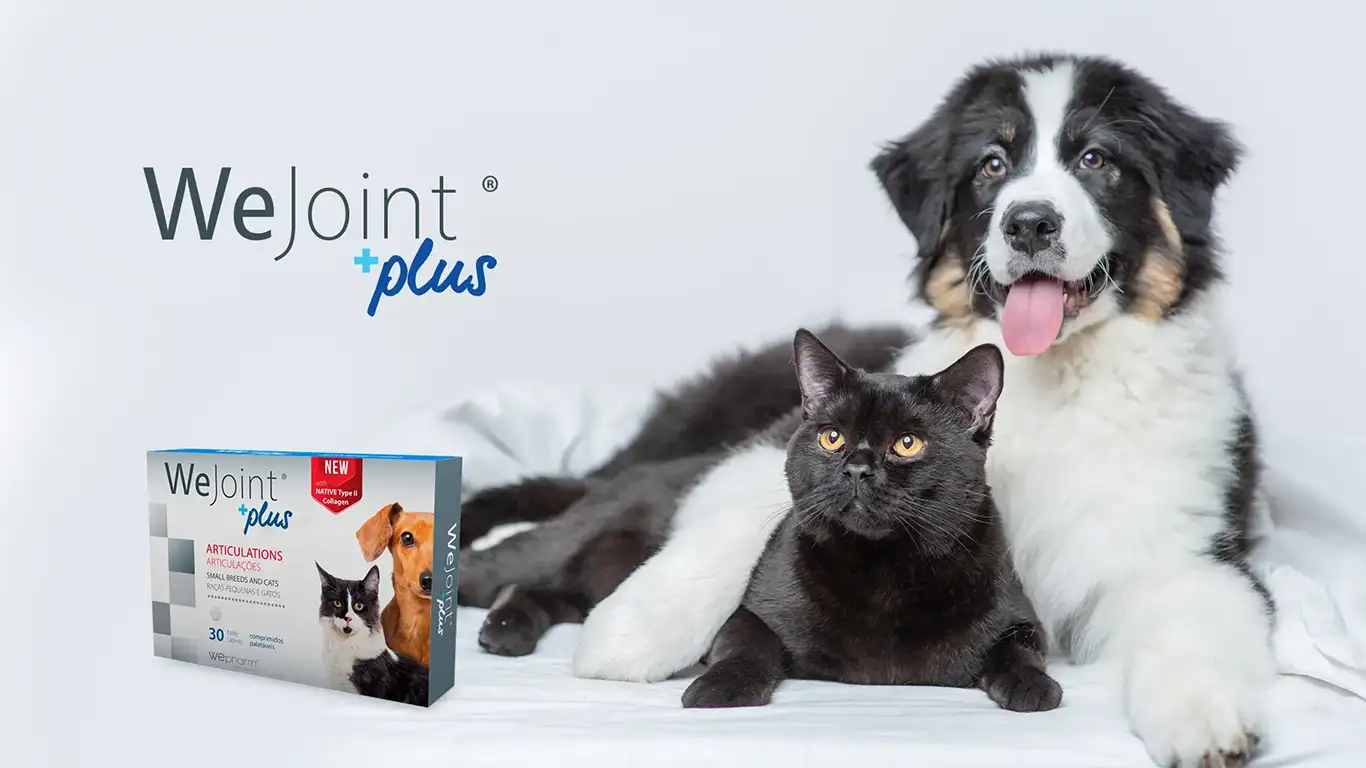
We Joint Plus® combines both approaches in a single formula: glucosamine, chondroitin, MSM, native type II collagen, krill oil, vitamin C, zinc, manganese and Harpagophytum extract (Devil’s claw). Highly palatable tablets, 30 per box.
Read on:
- Structure and role of collagen in articular cartilage
- Hydrolysed collagen: nutritive support for the extracellular matrix
- Native type II collagen: oral tolerance mechanism
- The significant difference in dosage
- Full composition of We Joint Plus®
- How to administer We Joint Plus®
- Clinical implications and the use of combined supplements
- Frequently asked questions
- Bibliography
Structure and role of collagen in articular cartilage
Collagen represents the main structural component of articular cartilage, constituting approximately 60% of its dry mass. The predominant type is type II collagen, which forms a complex fibrillar network that provides mechanical resistance and elasticity to the cartilaginous tissue.
In osteoarthritis, proteolytic enzymes such as matrix metalloproteinases (MMPs) contribute to the degradation of type II collagen and the progressive destruction of the extracellular matrix. This degradation is accompanied by a chronic inflammatory response that accelerates cartilage deterioration.
What does this mean for owners? The cartilage covering the ends of bones in joints wears down gradually. Once damaged, the body does not regenerate it easily. This is why joint supplements serve to slow down this process and reduce the associated pain.
Hydrolysed collagen: nutritive support for the extracellular matrix
Hydrolysed collagen is obtained through enzymatic or thermal processing of collagen, which causes the molecule to fragment into low molecular weight peptides. These peptides are easily absorbed at intestinal level and provide essential amino acids for connective tissue synthesis, particularly glycine, proline and hydroxyproline.
The mechanism of action is primarily nutritive and structural. The absorbed peptides are used by the body as a substrate for extracellular matrix synthesis and articular cartilage regeneration.
Due to this mechanism, hydrolysed collagen is administered in relatively large doses, usually in the range of 500 mg to several grams per day, depending on the animal’s weight.
Studies suggest that the resulting peptides can stimulate chondrocyte activity and increase collagen and proteoglycan synthesis in the cartilage matrix. However, the effect is dependent on a continuous amino acid supply and does not directly influence the immunological mechanisms involved in cartilage degradation.
Native (undenatured) type II collagen: oral tolerance mechanism
Native type II collagen is a structurally intact form of collagen, obtained through extraction processes that preserve the three-dimensional configuration of the molecule. This structure is essential for its mechanism of action.
Unlike hydrolysed collagen, native collagen acts through modulation of the immune response. After oral administration, native collagen molecules interact with the immune system associated with the gastrointestinal tract, particularly at the level of Peyer’s patches.
This process triggers the phenomenon of oral tolerance, characterised by the activation of regulatory T lymphocytes (Treg). These cells release anti-inflammatory cytokines such as interleukin-10 and TGF-β, which inhibit the immune response directed against endogenous collagen in the cartilage.
Through this mechanism, native collagen reduces joint inflammation and limits degradation of the cartilage matrix.
In simpler terms for owners: in osteoarthritis, the animal’s immune system mistakenly attacks its own cartilage. Native type II collagen “teaches” the immune system to stop attacking the cartilage, reducing inflammation and pain. It is effective in very low doses precisely because it does not work as a building material, but as a biological signal.
The significant difference in dosage
One of the most important differences between the two forms of collagen is the quantity required to achieve biological effects:
- Hydrolysed collagen – doses in the order of hundreds of milligrams or grams/day (nutritive mechanism, amino acid supply)
- Native type II collagen – effective in very low doses, ~40 mg/day in dogs with osteoarthritis (immunological mechanism, oral tolerance)
The clinical study by Deparle et al. (2005) demonstrated that supplementation with native type II collagen resulted in a significant reduction of pain during limb manipulation and an improvement in mobility in dogs with arthritis.
The study published by Stabile et al. (2019) showed that daily administration of native type II collagen for 90 days led to a significant reduction in pain and stiffness scores in dogs diagnosed with osteoarthritis.
Full composition of We Joint Plus®
We Joint Plus® is a nutritional supplement designed to support joint health in small-breed dogs and cats. It is available as highly palatable tablets (poultry flavour), 30 tablets per box.
Composition per tablet
- Glucosamine hydrochloride (crustacean) – 250 mg
- Chondroitin sulphate (bovine source) – 100 mg
- Methylsulphonylmethane (MSM) – 60 mg
- Krill oil – 40 mg (source of Omega-3)
- Vitamin C (ascorbic acid) – 22 mg
- Standardised Collagen (poultry) – 10 mg (contains Native Type II Collagen – 0.24 mg)
- Zinc sulphate monohydrate – 18.2 mg (Zn – 4.43 g/kg)
- Manganese sulphate monohydrate – 6.2 mg (Mn – 1.33 g/kg)
- Harpagophytum procumbens extract (Devil’s claw) – 1.6 mg
The formula thus combines 9 active ingredients with complementary mechanisms: structural support (glucosamine, chondroitin, collagen), anti-inflammatory action (MSM, krill, Harpagophytum, native type II collagen) and metabolic cofactors (vitamin C, zinc, manganese).
How to administer We Joint Plus®
Administration: tablets can be administered as they are or in the animal’s food, thanks to their high palatability (poultry flavour).
Initial dosage (first 15 days): doubling the recommended dose is advised for a faster initial loading phase.
Maintenance dosage: as recommended by the veterinary surgeon, depending on the animal’s weight and the severity of the condition.
Important precautions: Consult your veterinary surgeon before use to determine the administration period and the appropriate dose. This product should not replace a varied diet. Exceeding the recommended dosage is not advised. Store in a cool, dry place, away from direct light.
Clinical implications and the use of combined supplements
In clinical practice, modern joint health supplements frequently include combinations of ingredients with complementary mechanisms: glucosamine and chondroitin for structural support, MSM and krill for anti-inflammatory action, native type II collagen for immune modulation and trace elements (zinc, manganese) as enzymatic cofactors.
This approach allows for simultaneous support of cartilage structure, reduction of joint inflammation and improvement of mobility in animals affected by osteoarthritis.
We Joint Plus® is recommended for: growing animals, young animals with intense physical activity, animals with inflammatory, degenerative or traumatic joint conditions, and in situations where the joint is immobilised.
Understanding the differences between hydrolysed collagen and native type II collagen enables veterinary surgeons to choose the appropriate nutritional formulas for supporting joint health and improving the quality of life of affected animals.
Frequently asked questions
Hydrolysed collagen provides amino acids as a nutritive substrate for cartilage regeneration – a structural mechanism requiring large doses (hundreds of mg to grams/day). Native type II collagen modulates the immune response through oral tolerance, reducing joint inflammation – an immunological mechanism effective in very low doses (~40 mg/day).
Oral tolerance is a phenomenon through which the immune system learns to stop attacking the body’s own cartilage collagen. Native type II collagen, administered orally, interacts with the immune system at the level of Peyer’s patches in the intestine and activates regulatory T lymphocytes that release anti-inflammatory cytokines (interleukin-10, TGF-β).
Each tablet contains: glucosamine 250 mg, chondroitin 100 mg, MSM 60 mg, krill oil 40 mg, vitamin C 22 mg, standardised collagen with native type II collagen 10 mg, zinc 18.2 mg, manganese 6.2 mg and Harpagophytum extract 1.6 mg. The formula combines 9 active ingredients with complementary mechanisms.
The tablets are administered orally, as they are or in food. Doubling the dose during the first 15 days (loading phase) is recommended, followed by the maintenance dose established by the veterinary surgeon. The tablets are highly palatable (poultry flavour).
No. Limping requires first and foremost a veterinary consultation for a correct diagnosis (radiography, clinical examination). Joint supplements such as We Joint Plus® provide nutritional support, not a replacement for medical treatment. Osteoarthritis management is multimodal: weight control, pharmacological therapies and supplements.
Krill oil is a source of Omega-3 fatty acids with an anti-inflammatory effect. Omega-3 contributes to reducing synovial inflammation and complements the anti-inflammatory action of MSM and Harpagophytum extract in the formula.
Harpagophytum procumbens (Devil’s claw) is a plant whose root extract is traditionally used for its anti-inflammatory and analgesic properties. In We Joint Plus® it is included as a complementary natural ingredient for reducing joint pain.
Yes. We Joint Plus® Small Breed and Cats is specifically formulated for small-breed dogs and cats. The dose is determined by the veterinary surgeon based on the animal’s weight and the severity of the joint condition.
Bibliography
- Deparle L.A. et al. (2005). Efficacy and safety of glycosylated undenatured type II collagen in arthritic dogs. Journal of Veterinary Pharmacology and Therapeutics.
- Stabile M. et al. (2019). Evaluation of the effects of undenatured type II collagen in dogs with osteoarthritis. Veterinary Medicine International.
- Varney J.L. et al. (2022). Impact of supplemented undenatured type II collagen on pain and inflammation in Labrador Retrievers during exercise. Translational Animal Science.
- Gencoglu H. et al. (2020). Undenatured Type II Collagen (UC-II) in Joint Health and Disease. Animals.
- Zhang Y. et al. (2023). A scoping review of undenatured type II collagen and joint health. Animals.
Further reading
- Liver protection in veterinary medicine: why efficacy does not depend on a single ingredient
- External parasite control in dogs and cats: disease prevention and vector control
- We Tasty: the new generation of chewable supplements for dogs and cats
- Otitis in dogs and cats: the role of Peptivet 4 in modern ear infection management
Medical disclaimer: This article is for informational purposes only and does not replace a veterinary consultation. For specific recommendations, contact your veterinary surgeon.