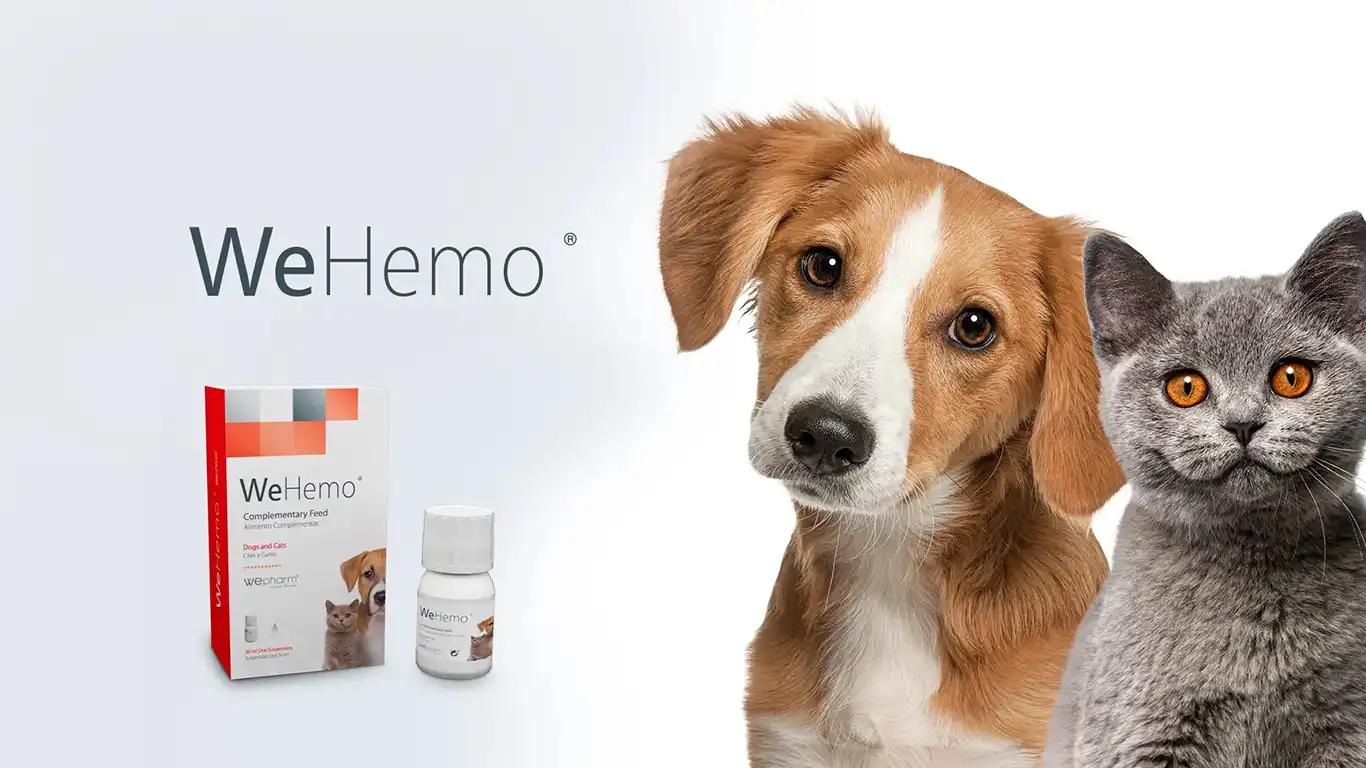
In veterinary practice, anaemia is a frequent consequence of haemorrhage, haemoparasitic disease, chronic conditions, or convalescence. In such situations, iron supplementation is often part of the therapeutic plan. However, its efficacy depends not only on the amount of iron administered, but also on the chemical form in which it is made available to the body.
If you are a veterinary surgeon, this article explains the scientific basis of the chelated form and the full composition of WeHemo®. If you are a pet owner and your dog or cat has been diagnosed with anaemia, you will understand why your vet may recommend a supplement based on chelated iron, how it is administered, and exactly what it contains.
Quick summary
Iron in veterinary supplements can be present as inorganic salts or as chelates. The difference directly affects intestinal absorption and the mineral’s bioavailability.
WeHemo® uses Iron (II) Chelate of Glycine Hydrate, a form with superior bioavailability that is less influenced by interactions with other compounds in the diet.
Besides iron, the formula contains zinc and copper chelate of glycine, B-complex vitamins, folic acid, vitamin C, vitamin K, taurine, and essential amino acids (L-Lysine, DL-Methionine, L-Threonine, L-Valine, L-Arginine).
It is administered orally, using the dosing syringe provided: 0.1 ml/kg body weight (equivalent to 2 drops/kg). 30 ml bottle.
It may be beneficial in: iron-deficiency anaemia, acute or chronic haemorrhage, haemoparasitosis, post-operative convalescence, recovery after trauma, and chronic conditions associated with anaemia.
Jump to:
Not all iron sources are equal
Iron in complementary feed can be present as inorganic salts (such as ferrous sulphate) or as chelates (compounds in which the metal ion is bound to an amino acid). The difference is significant because it affects intestinal absorption and the bioavailability of the mineral.
Inorganic iron salts, commonly used in conventional supplements, may be less efficiently absorbed and are more susceptible to interactions with other compounds in the diet. Chelated forms, by contrast, offer an alternative with superior bioavailability.
What does this mean for pet owners? If your vet has diagnosed anaemia in your dog or cat and recommends iron supplementation, the chelated form may mean that the animal’s body takes up iron more efficiently from each dose administered.
What is chelated iron and how does it work
WeHemo® uses Iron (II) Chelate of Glycine Hydrate (additive code 3b108), a chelated form of iron in which the ferrous ion is bound to glycine. Compared with the inorganic forms commonly used, chelated iron exhibits superior bioavailability and is less influenced by interactions with other compounds in the diet, which favours efficient intestinal absorption.
This chemical form allows the body to take up iron more efficiently at the intestinal level, reducing the losses associated with interactions with other nutrients or compounds present in the animal’s feed.
The iron concentration in WeHemo® is 6 g of iron per litre of product, supplied exclusively as a glycine chelate.
An advantage beyond iron: the full WeHemo® composition
Haematopoiesis is a complex process, and iron is only part of the equation. Haemoglobin synthesis and erythrocyte maturation also require other essential cofactors. This is why WeHemo® contains not only iron in a highly absorbable form, but also zinc and copper, both as glycine chelates.
Chelated trace elements
- Iron (II) Chelate of Glycine Hydrate (3b108) — iron: 6 g/L
- Zinc Chelate of Glycine Hydrate (3b607) — zinc: 5.5 g/L
- Copper (II) Chelate of Glycine Hydrate (3b401) — copper: 552 mg/L
Vitamins and cofactors
- Folic acid (3a316) — 12 g/L
- Calcium D-pantothenate (3a841) — 5.4 g/L
- Niacinamide (vitamin B3, 3a315) — 5 g/L
- Vitamin C (ascorbic acid, 3a300) — 5 g/L
- Vitamin B2 (riboflavin, 3a826) — 4.4 g/L
- Vitamin B1 (thiamine, 3a820) — 4 g/L
- Vitamin B6 (pyridoxine, 3a831) — 3 g/L
- Vitamin K3 (menadione, 3a710) — 0.5 g/L
- Vitamin B12 (cyanocobalamin) — 0.3 g/L
- Taurine (3a370) — 0.5 g/L
Amino acids
- L-Lysine — 0.5 g/L
- DL-Methionine — 0.5 g/L
- L-Threonine — 0.5 g/L
- L-Valine — 0.5 g/L
- L-Arginine — 0.5 g/L
The formula is completed by ingredients such as malt extract (barley, maize), propolis, and grapefruit extract, in an easy-to-administer liquid base.
How to administer WeHemo®
WeHemo® is presented as a 30 ml bottle with a dosing syringe included, allowing precise and straightforward dosing.
Administration: oral.
Recommended dose: 0.1 ml per kg body weight (equivalent to 2 drops of WeHemo® per kg).
Practical dosing examples
- Cat weighing 4 kg — 0.4 ml (8 drops)
- Dog weighing 10 kg — 1 ml (20 drops), using the dosing syringe
- Dog weighing 25 kg — 2.5 ml, using the dosing syringe
Storage precautions: keep in a dry place, below 25 °C, protected from light and direct heat. Once opened, the product is valid for 2 months. Keep out of the reach of children.
When WeHemo® may be beneficial
WeHemo® is a nutritional supplement for dogs and cats, indicated in cases of anaemia. It can provide valuable support in the following clinical situations:
- Iron-deficiency anaemia — when iron deficiency is the primary cause of anaemia
- Acute or chronic haemorrhage — when blood loss creates an increased iron requirement. In cases of coumarin anticoagulant poisoning, haemorrhagic anaemia is one of the most common consequences (see the article on coumarin anticoagulant poisoning)
- Haemoparasitosis — when blood parasitism impairs red blood cell production. Consistent ectoparasite control reduces the risk of such anaemias (see the article on ectoparasite control in dogs and cats)
- Post-operative convalescence — when the body requires haematological support following surgery
- Recovery after trauma — when blood loss or physiological stress increases the iron requirement
- Chronic conditions associated with anaemia — when a long-standing disease affects haematological parameters
Important for pet owners: WeHemo® is a nutritional supplement, not a medicinal product. It should be administered on the recommendation of a veterinary surgeon, as part of a comprehensive therapeutic plan, and not as a substitute for medical treatment.
Why form matters, not just quantity
When choosing a complementary feed intended to support haematopoiesis, it is worth looking beyond the amount of iron stated on the label. The form in which trace elements are supplied can influence how effective the supplementation proves to be.
By using iron, zinc, and copper as glycine chelates, alongside vitamins, amino acids, and cofactors involved in erythropoiesis, WeHemo® offers a modern and comprehensive formula to support dogs and cats that require haematological support.
The approach of combining multiple active ingredients with complementary roles, rather than relying on a single isolated nutrient, is the same philosophy applied in veterinary hepatic protection.
Frequently asked questions
Chelated iron is a form of iron in which the ferrous ion is bound to an amino acid — in the case of WeHemo®, to glycine. This binding protects the iron from interactions with other compounds in the diet, favouring efficient intestinal absorption and superior bioavailability compared with inorganic iron salts.
WeHemo® uses Iron (II) Chelate of Glycine Hydrate (additive code 3b108), at a concentration of 6 g of iron per litre of product.
In addition to chelated iron, WeHemo® contains zinc and copper chelate of glycine, B-complex vitamins (B1, B2, B3, B6, B12), folic acid, vitamin C, vitamin K, taurine, and five amino acids (L-Lysine, DL-Methionine, L-Threonine, L-Valine, L-Arginine). The formula also includes propolis and grapefruit extract.
It is administered orally, using the dosing syringe supplied with the bottle. The dose is 0.1 ml per kg body weight (equivalent to 2 drops per kg). For example, a 4 kg cat receives 0.4 ml, and a 10 kg dog receives 1 ml.
Once opened, the product is valid for 2 months. It should be stored in a dry place, below 25 °C, protected from light and direct heat.
WeHemo® can provide valuable nutritional support in: iron-deficiency anaemia, acute or chronic haemorrhage, haemoparasitosis, post-operative convalescence, recovery after trauma, and chronic conditions associated with anaemia. As a supplement, it should be administered on the recommendation of a veterinary surgeon.
Haematopoiesis is a complex process. Haemoglobin synthesis and erythrocyte maturation also require other essential cofactors, including zinc and copper. WeHemo® supplies these trace elements as glycine chelates as well, contributing to enhanced bioavailability.
No. WeHemo® is a nutritional supplement, not a medicinal product. It should be administered as part of the therapeutic plan established by a veterinary surgeon, not as a substitute for medical treatment. If your animal shows signs of anaemia (pale gums, lethargy, loss of appetite), the first step is a visit to the veterinary practice, not self-directed supplementation.
Further reading
- Ectoparasite control in dogs and cats: disease prevention and vector management
- Coumarin anticoagulant poisoning in animals: mechanism, diagnosis, and treatment
- Hepatic protection in veterinary medicine: why efficacy does not depend on a single ingredient
- We Tasty: the new generation of chewable supplements for dogs and cats
- The role of hydrolysed collagen and native type II collagen in joint supplements
⚠️ Disclaimer: This article is for informational purposes only and does not replace a veterinary consultation. For specific recommendations, contact your veterinary surgeon.